Definition
What is Sovereign AI?
A plain-English definition of sovereign AI, the four things you must control, and why regulated enterprises and nations choose it.
By James Drayson
In short
Sovereign AI is enterprise AI you fully own and control, the model weights, the infrastructure, the data path, and the cadence of every update, deployed inside your own perimeter instead of accessed through a third-party API.

Four things you must control
"Sovereignty" is often used loosely. For AI it has a precise meaning: control over the four layers that decide whether the system is genuinely yours or merely borrowed.
- The model: You hold the weights and the intellectual property, not an API key against someone else's frozen model that can be changed or withdrawn.
- The infrastructure: The model runs on hardware you control, on-premise, in your private cloud tenant, air-gapped, or in a sovereign cloud in your jurisdiction.
- The data path: Prompts, documents, and outputs never leave your perimeter. Nothing is sent to a foreign region or absorbed into a third party's training set.
- The update cadence: You decide when and how the model changes. It is retrained on your data on your schedule, rather than silently swapped by a vendor.
Built for regulated buyers
Sovereign AI exists because the most valuable AI in a bank, hospital, government department, or research lab cannot sit behind a general-purpose API in another country. Four buyer needs drive the shift.
- Data residency: Sensitive data stays inside the jurisdiction and perimeter where it is legally required to live.
- Auditability: Full access to weights, training data, and the post-training process gives you the traceability auditors and regulators expect.
- Operational autonomy: No vendor can deprecate, rate-limit, or revoke the model you depend on. It runs on your terms.
- Cultural and legal fit: The model is grounded in your languages, laws, and institutional knowledge, not the averaged public internet.
How Locai delivers sovereign AI
Locai Labs builds sovereign models by post-training a strong open base on your proprietary data using the Forget-Me-Not framework, which adapts the model to your domain while preserving its general reasoning (avoiding catastrophic forgetting). You receive the weights, an application layer, and a deployment of your choosing, and the model is retrained on a cadence so it compounds in value the longer your team uses it.
What this looks like with Locai
Sovereignty stops being a contractual promise when the machine is standing in your own building. Here is what that looks like in practice.
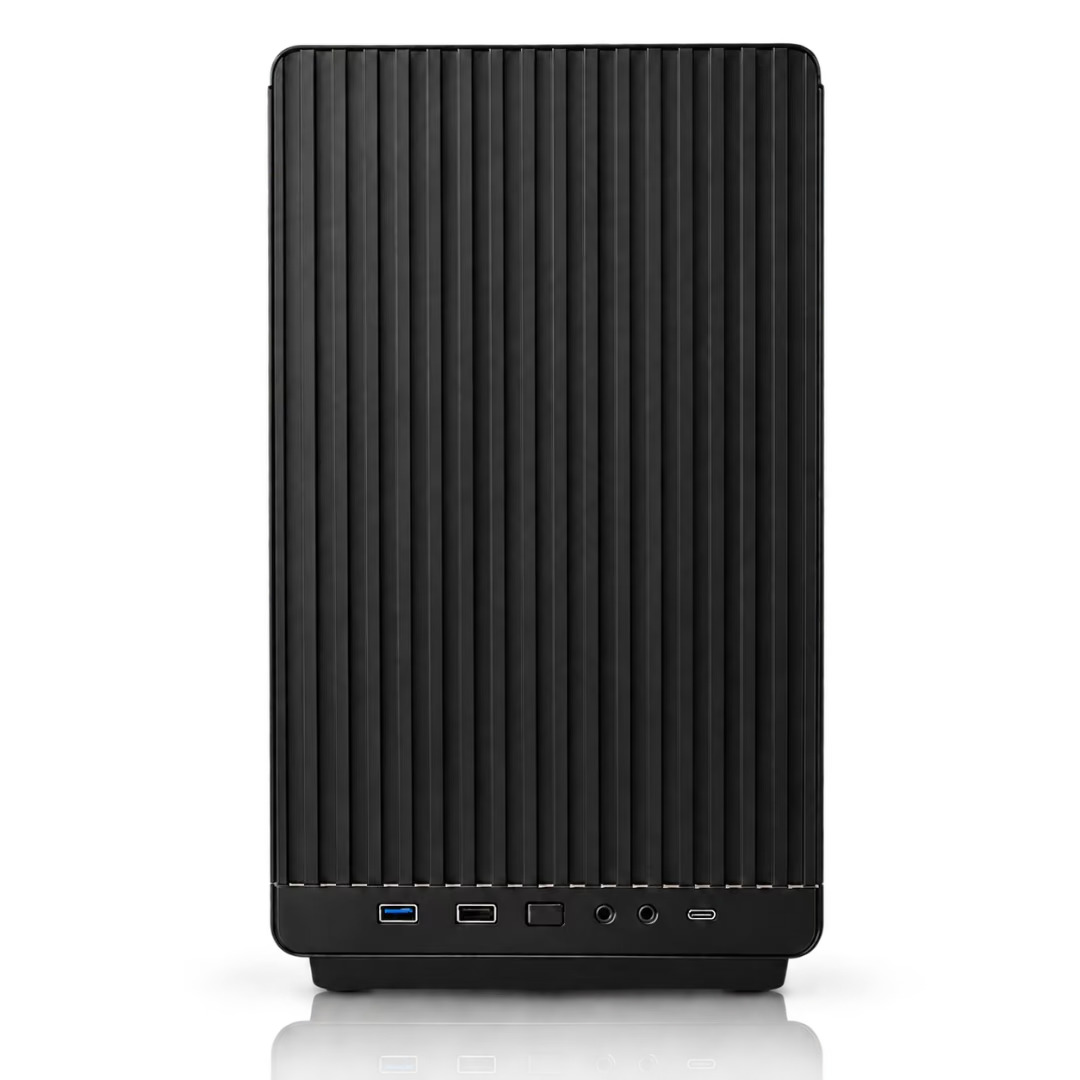
Locai Labs builds Locai One, an on-prem AI appliance. It is one machine that arrives with everything already in it: the hardware, our open-weight Locai Juno models, and Locai OS, the operating system that serves the models and handles users, access and monitoring. You plug it into a mains socket and your network, and your team is working in about 15 minutes. No cloud account, no per-token bill, and nothing leaving the building.
The reason a data-centre-class model fits in a box on your floor is SPACE, our compression algorithm. Instead of asking how much of a model can be cut while keeping it broadly similar, SPACE asks what the model needs to be good at, preserves the subnetworks behind those capabilities and strips back the rest. The result is a smaller specialist rather than a shrunken generalist, tuned to the exact hardware it ships on.
Locai One starts at £29,950 for a team, and Locai One Pro at £49,950 for an organisation, bought once and owned outright. Both run air-cooled on standard mains power and work fully air-gapped. Any compatible open-weight model runs alongside Juno, and if you need a model trained on your own proprietary data we can post-train one and deploy it on the same machine.
Frequently asked questions
Is a private API endpoint the same as sovereign AI?
No. A private or dedicated endpoint can improve isolation, but if you do not hold the weights and the vendor still controls updates and can withdraw access, the model is rented, not sovereign. Sovereignty requires ownership of the model layer, not just network isolation.
Is sovereign AI the same as on-prem AI?
On-prem is one way to achieve infrastructure sovereignty, but sovereign AI is broader: it also requires owning the weights, the data path, and the update cadence. You can run sovereign AI on-prem, air-gapped, or in a sovereign cloud in your jurisdiction.
Does sovereign mean a weaker model?
No. Locai post-trains strong open base models and specialises them on your domain, so they can match or beat much larger general models on the tasks you actually care about, while remaining fully yours.
Who needs sovereign AI?
Regulated enterprises (finance, healthcare, legal, energy, telecoms, public sector), governments, and research organisations, anyone for whom data residency, auditability, IP ownership, and operational autonomy are non-negotiable.
Book a sovereign AI briefing
A 30-minute session on owning your model: deployment options, the data path, and a clear cost range for your use case.